Made-to-measure corner wardrobes in Lorca
A corner is a tricky spot: two walls meeting and a back corner that's hard to reach. A corner wardrobe turns it into useful storage, with doors that wrap around the angle and an interior designed so you can reach every last inch. If you're looking for made-to-measure corner wardrobes in Lorca, the first thing to decide is whether the unit will be one continuous L or two sections that meet, and how each set of doors opens without clashing with the other.
Shape your next wardrobe.
Try out the measurements, plan the interior layout and choose your finishes. See your idea take shape and share it with us so we can prepare your quote.
Send us your configuration with your measurements and we'll give you a guide price within 24 hours, free of charge. The measuring visit at your home comes afterwards.
What we can solve with a corner wardrobe
A corner wardrobe makes sense when your bedroom has an empty corner, when two adjoining walls offer space that a single run of doors can't make use of, or when the unit needs to reach a window without leaving dead gaps. Compared with a straight wardrobe, it adds capacity for the same footprint.
It isn't a walk-in wardrobe: there's no room to step into, just a unit that wraps around the angle and is used from the outside. That's why it's designed differently. Each arm of the L has its own width and its own access, and the area at the corner is treated as a module in its own right, not as leftover space. This planning avoids the classic corner nobody can reach.
L-shaped wardrobe, corner module and continuous fronts
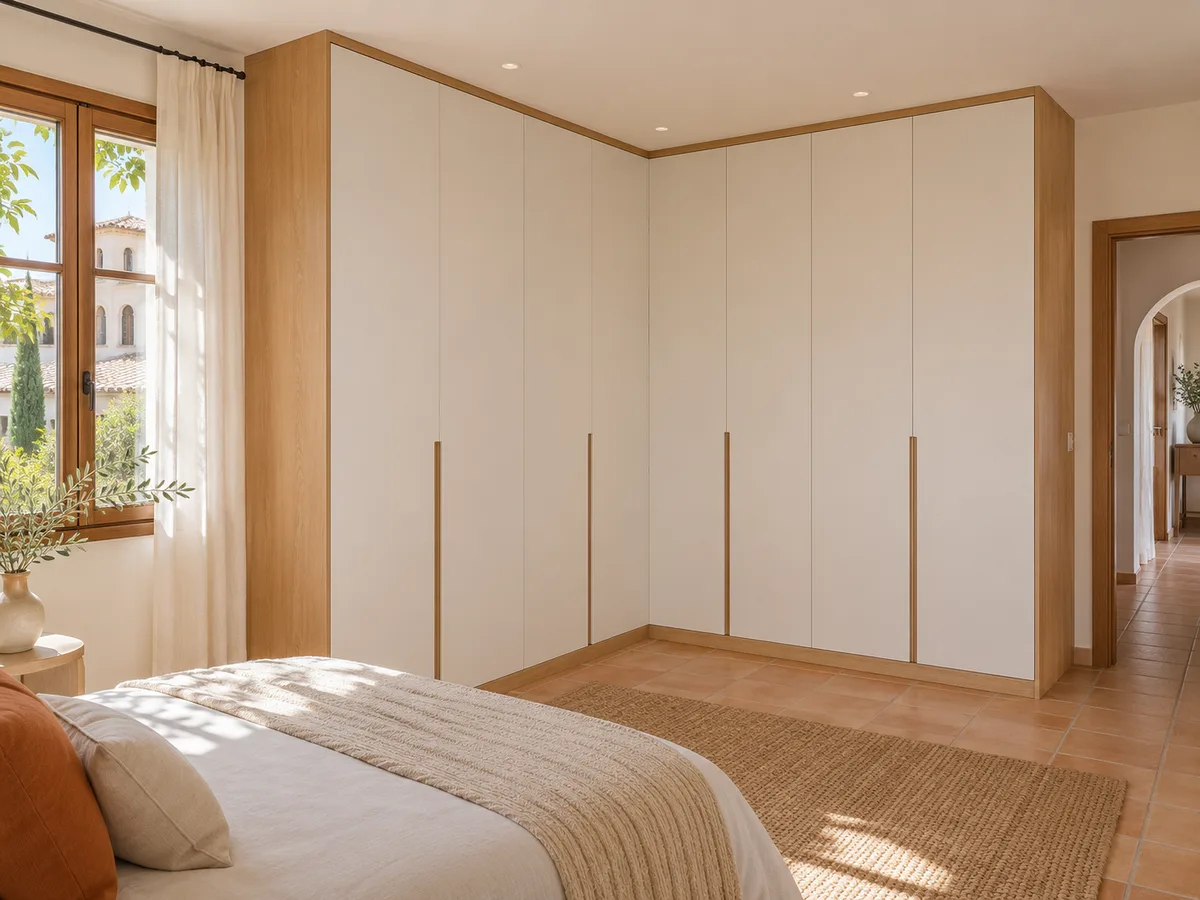
There are three ways to deal with the angle. The first is an L-shaped wardrobe built as a single unit, where the doors turn the corner with a 90-degree piece. It looks very clean, but the corner is a deep space that needs a good access system.
The second is to join two straight wardrobes that meet at the corner, each with its own doors. It's simpler to build and fit, and avoids the awkward deep corner, although the corner ends up slightly narrower. The third is a corner module with revolving or pull-out shelves, flanked by two straight sections. Choosing between the three depends on how much you value visual continuity against ease of use, and it's decided once we've seen the measurements of each wall.
How to reach the back without creating unusable areas
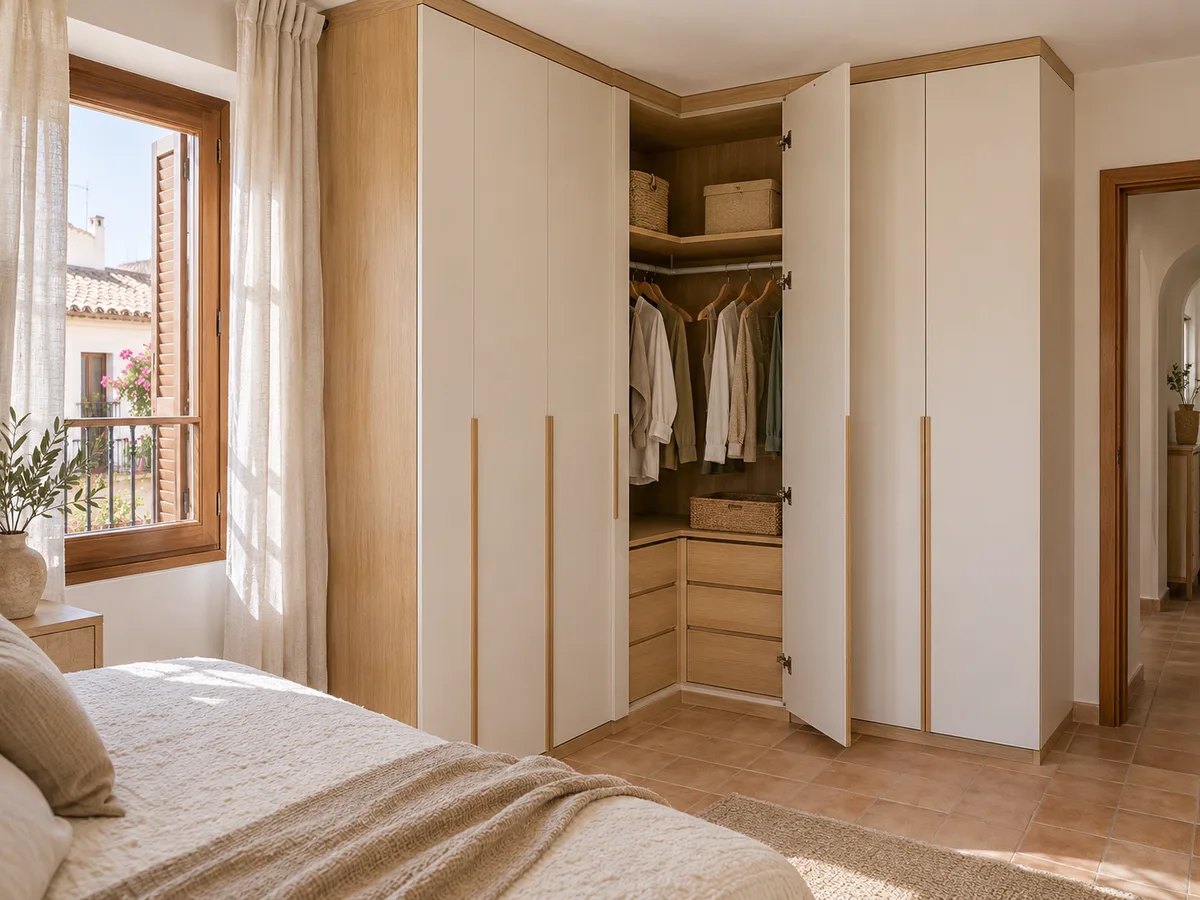
The big challenge with a corner wardrobe is the corner itself: two depths that cross and a dark area in the middle. If it isn't thought through, that's where everything you never use ends up.
The solutions are practical. L-shaped shelves that reach the back and can be swept with your hand, revolving trays that bring the contents out towards you, corner rails that open with a swivelling door or, simply, reserving the corner for things you rarely use: suitcases, out-of-season clothes, boxes. That section is treated as the long-term storage, and everyday access is prioritised in the two side arms. That way a corner wardrobe performs well without any expensive gimmicks.
Have you already measured the space?
Send us a photo and the approximate measurements on WhatsApp and we'll give you some initial guidance.
Doors and drawers that don't get in each other's way
- 01
Where two sets of doors meet, they can collide. A hinged door on the first arm swinging towards the corner can bump into the door on the second, and a drawer that pulls out can be blocked by the neighbouring door.
- 02
To avoid this, the opening is designed with as much care as the interior: one door opens one way and its neighbour the other, a fixed panel is left on each side of the corner, or sliding doors on one arm are combined with hinged doors on the other. Drawers go in the arm where no doors get in the way. The result is a unit where no opening blocks the next, which we check on the plan by drawing the swing of each door.
Adapting to walls, windows and walkways
Real corners are rarely perfect: a wall may not be plumb, the angle may open up by a few degrees, or a window may sit just a few centimetres from the corner. All of this is picked up when measuring up and solved with adjustment pieces made to fit that particular corner.
When there's a window frame, a doorway or a radiator nearby, the wardrobe is cut back or set in at that point. A shorter arm with deeper shelves makes up for what's lost on the other side. In homes in Lorca with older corners, deviations of a centimetre or two are common, and the doors are designed with a compensation joint so it doesn't show.
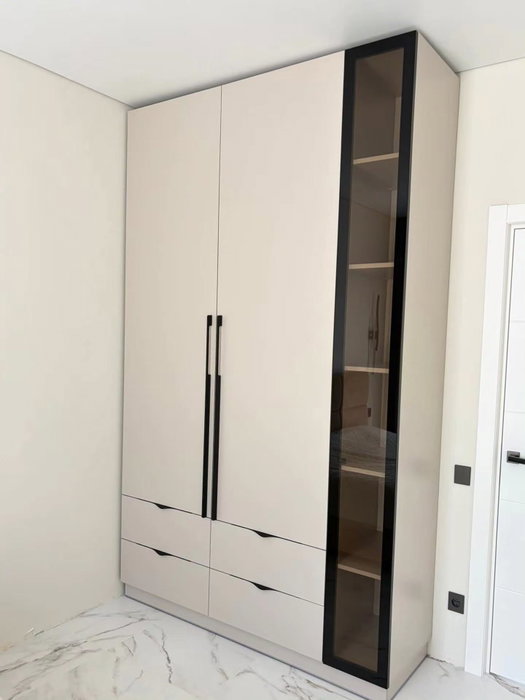
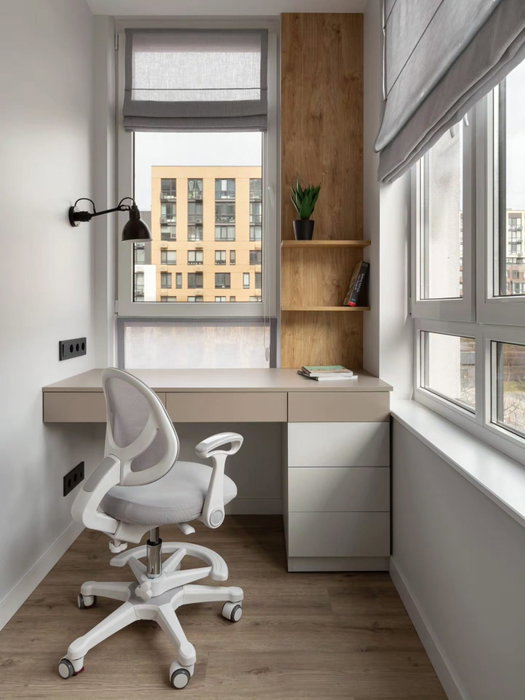
Latest work by SI, ARMARIO
@si.armario
Made-to-measure wardrobes and walk-in wardrobes
Latest posts
What changes when measuring a corner in Lorca
Measuring a corner isn't just measuring two walls separately. We need to take the width of each wall at three heights, the ceiling height at several points, the real angle between the two walls and the distance to the first obstacle on each arm.
A photo of the whole corner and another of each wall help us see what the tape measure doesn't pick up. With that information, the configurator prepares a design and sends it, and the team gives you an indicative price; then the measuring visit is scheduled, which costs €50 if you don't place an order and is free if you do. Measuring the angle twice stops a corner wardrobe arriving crooked and not closing properly.
Ask us to come and measure up in Lorca
- 01You leave us your name and your area.
- 02We message you on WhatsApp to agree a day.
- 03The measuring visit costs €50 and is free if you place an order.
What to store in each section of a corner
A corner wardrobe works best when each section has its own purpose. The arm closest to the bedroom door is kept for everyday items: shirts, trousers, underwear drawers. The opposite arm suits coats and long dresses, because it's opened less often and can take a higher rail.
The corner is left for bulky, rarely used items: suitcases, blankets, duvets, seasonal boxes. With that logic, a corner wardrobe works almost like a vertical corridor: what you use every day within easy reach, what you use once a quarter at the back. If you reverse the arrangement, the corner stops being an advantage and turns into a dumping ground, which is why it's worth deciding this before the shelves are drawn.
What to check in the design before we build
- 01
Before giving the green light, it's worth checking five things: whether the corner can be accessed, whether any doors clash with each other, whether the drawers pull out fully, whether the rail heights are comfortable on each arm, and whether the doors line up with windows and skirting boards.
- 02
The finish is also confirmed. A corner wardrobe has a lot of visible surface, with two sets of doors facing you, so a dark colour or a design with very pronounced grain has more visual weight than on a straight wardrobe. Any doubts are settled on the plan, not on the finished unit. If you'd like to see how the whole process works, it's explained in how we work, and manufacturing takes around 2 to 3 weeks on average.
Enquiry
Tell us about your project in Lorca
- 1We read your message and look at your photos.
- 2We reply on WhatsApp with a first figure.
- 3We measure up and prepare the final quote. The measuring visit costs €50 if you don't go ahead with the order and is free if you do.
We don't cut a single board until you've approved the design and the price.
Questions
Frequently asked questions about wardrobes in Lorca
After installation: warranty and care for your wardrobe.
Does a corner wardrobe offer more capacity than a straight one?
It depends. You gain space if the corner was empty and the inner corner is reasonably accessible. If not, part of the volume ends up as hard-to-reach storage. The design determines how much of that space you genuinely use.
How do you hang clothes in a corner?
The usual approach is to put the rails in the two arms, where access is from the front, and leave the corner for shelves, boxes or rarely used clothes. That way you don't have to reach right to the back.
Can you mix sliding and hinged doors in the same corner wardrobe?
Yes, and sometimes it's the best way to avoid clashes. One arm with sliding doors and the other with hinged doors shares out the space, as long as the swing is checked on the plan.
L-shaped wardrobe or L-shaped walk-in wardrobe: which is right for me?
An L-shaped wardrobe is used from the outside, with doors, and takes up one corner of the room. An L-shaped walk-in wardrobe is a space you step into and move around in. If you only have a corner available, the wardrobe is the more realistic choice.
Is a made-to-measure corner wardrobe in Lorca worth it?
If you have an unused corner or a room with two long walls, yes. A standard model rarely fits the real angle, and a made-to-measure wardrobe closes it off with no gaps or leftover pieces.
Shall we talk about your project?
Send us a photo of the space and some approximate measurements on WhatsApp: we'll give you some initial guidance and arrange the measuring visit.